What Does It Mean To Have an 'Interactive' Church Service?

jeff • June 3, 2021

“We’d like to get more   interaction   in our church service.”  This is perhaps the most common sentiment expressed whenever we meet with a church leader.  Engagement, interaction, feedback, discussion.  Somehow, this adjective is absent from church online.

This is such a sign of the times. These words that   never used to   describe a church service.

What did leaders and churchgoers appreciate prior to Covid?  For sure, you would hear descriptions of the worship. Not just the various styles of worship, but we heard about the impact of the music selection and performance. Was it uplifting? Peaceful and calming? Powerful? Transcendent? 

And the message. Was it insightful? Did it speak to me? Was it challenging? 

And the readings. And the sacraments.  And the corporate prayer. There are all sorts of ways to describe these elements or a church service.

But… interactive?  Engaging?  Did anyone ever greet the pastor or the worship leader at the end of service or Mass and say, “that was really   engaging ?”  Did the leadership team ever meet on Monday morning and reflect how   interactive   the congregation was on Sunday?  

Obviously, something about online worship is missing, and much of it falls under the banner of interactivity, or engagement. And, by this, everyone is thinking beyond Likes, or Shares or emojis. If that’s what everyone meant, then we’re all done, problem solved. Emojis for everyone!

Also, interactivity and engagement must mean more than direct back-and-forth communication between the leader(s) and the attendees.  Sure, an occasional   amen!   or   preach!   shouted out in the chat is appreciated. But, again, if that is what people are looking for, that problem has also been solved. 

Interactivity Is About Community, Not About Who's Up Front

Clearly, the interaction that people generally experienced in pre-Covid days was   with each other ! In increasing degrees of intimacy, people interact and engage in these ways. 

  • I see my people.   Ever sit in the back row?  Or, ever wonder what those people are doing sitting in the back row?  One of the truly wonderful experience sitting in the back, or in the middle for that matter, is the feeling of being where you belong. There is something healing and wholesome about feeling among one’s tribe. It is not entirely unlike being among the thousands of fans at a sporting event or a concert, brought together, unified by a common devotion to the performers. In church, we are unified by our faith. There is something special about simply being among fellow believers. 
That actually counts as interactivity, as engagement.  Belonging is an engaging experience.At Altar Live, we hear from our church customers that simply seeing the full roster of attendees approximates this sense of being among the church family. 
  • I see my friend.   For the less talkative among us, this one is a favorite. In the church building, I make eye contact with friends. It could be someone from my men’s small group, or a member of their family. A quick nod or a wink goes a long way of feeling connected, even without a full-on conversation. 

    One of the big absences of social-media church is that you aren't aware of a particular individual's presence online, unless they are part of the 5-10% of attendees who say something in the chat.  But, even then, there isn’t really a way to give a private, quiet hello in that setting. 

    The ability to have 1:1 or a small group chat among friends to simply say hi and do a virtual handshake
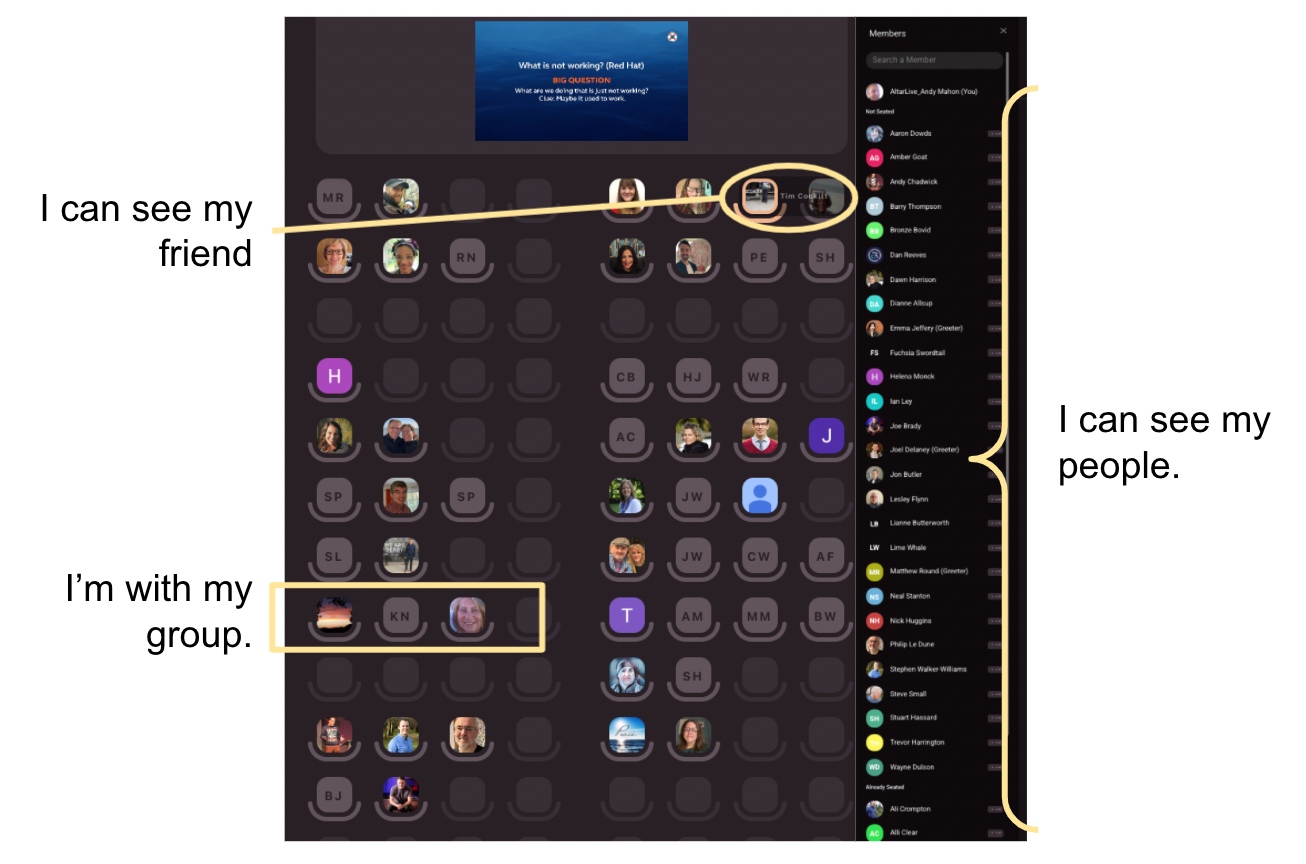
An interactive church service
  • I’m with my group.   Early on in the pandemic, Altar Live was exploring ways to connect people in small rows or groups to watch a church service together, and use videoconferencing to talk among themselves. “Why would people want to talk during the church service?” we heard over and over -- from pastors.  We never heard that from churchgoers. The fact is that lots of people interact with their seat neighbor, making small observations or asking quick questions. What’s more, youth pastors would tell us that the young people were actually already talking to each other in church, but on social media on their phones.  

    People like to “sit with” their group online. That could mean far-flung family members or friends, or friends with whom a simple hello or a nod is not enough. Can these people find a private space to see one another face to face online? Can they form a group chat just for this event? 

    Now we’re talking interactive! 

    This kind interactivity is peer-wise, not oriented towards what is happening up front. This is a crucial difference that does not necessarily occur to many leaders at first. The interactivity that people miss and crave is not between them and the leadership, it is among themselves. 
  • I’m with my pastor. Okay, okay, pastors, don’t worry, people want to engage with you too! (and you with them).   A recent Barna research report showed that contact with pastors and leaders was among the top things people have missed during the pandemic. For many, this means just a brief connection, some reassurance that all is well, that they are not forgotten or overlooked.

    And, of course, this is hugely important for pastors, the shepherds of their flock. They want to get a sense of who is in need, or to share a celebration, or to notice if someone has wandered away. The ability to have a specific space where the pastor and congregants can meet privately   after the church service   is a powerful part of an interactive church service.
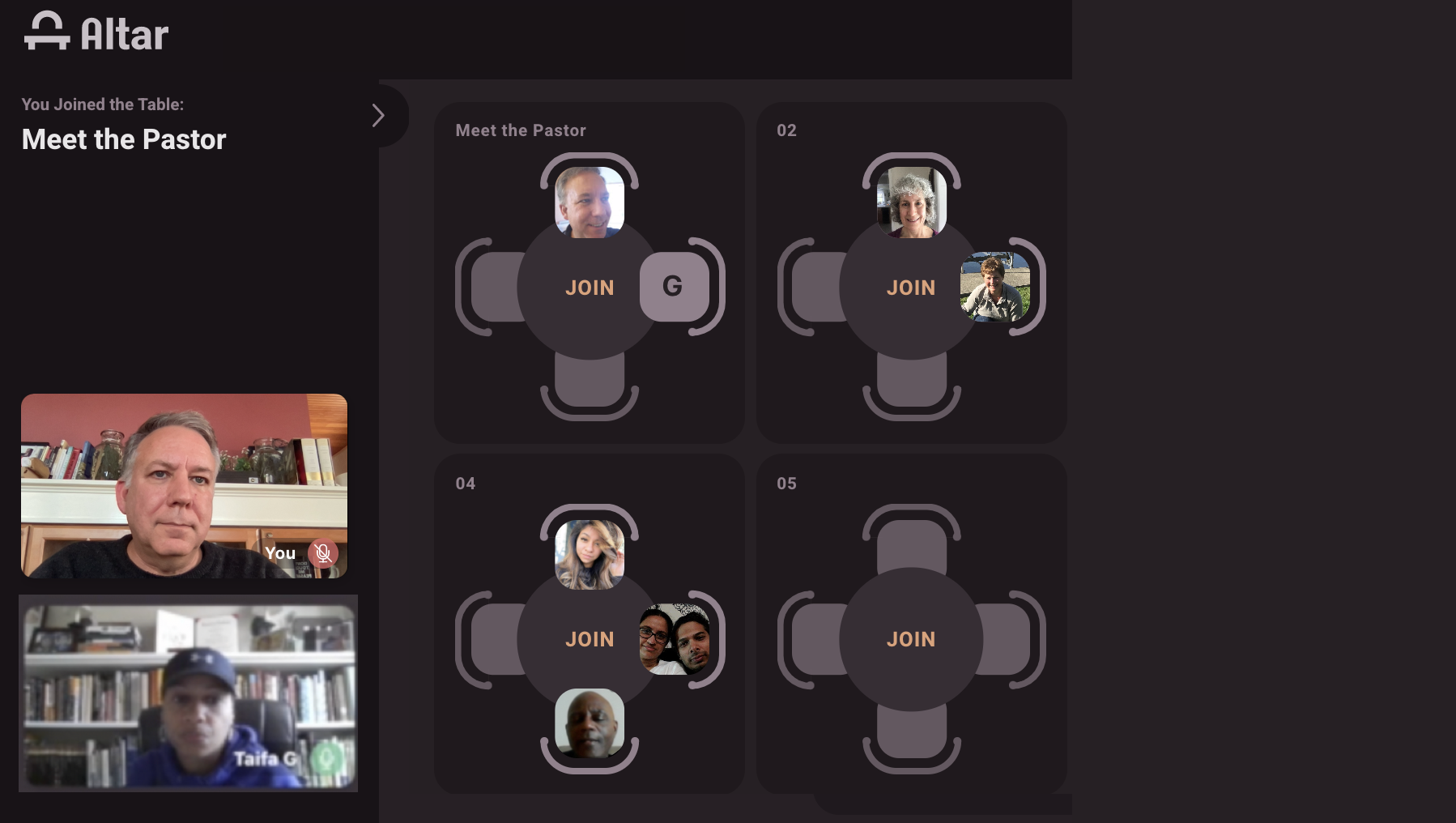
Meet the pastor and mingle with others
  • I can mingle.   A few minutes with the pastor, and that’s enough. It’s time to meet and greet with the gathered throng. Now, as an extrovert, I want to make the rounds a bit, and join a conversation or two. In the church building, I do this organically, spying a lone individual or a group of people whose body language suggests they are open to talking. I don’t want to be assigned to someone (and vice versa, I am sure). And, I certainly don’t want to get locked into a conversation that it’s hard to get out of.  I’d like to sort of scan the room, and find an opportune way to connect. 

    This is a big part of what everyone understands as community. To the degree that we are looking for community online, this sort of organic connection is a key part of it. 
  • I can pray with someone.   I have attended many churches where there were rooms close by to the sanctuary, spaces set aside where two or more could gather for prayer. I have sought out those rooms myself, sometimes when the message or worship particularly moved me, and actually more often when I was going through a particularly rough stretch of circumstances, or doubt, or grief. In other seasons, I have made myself the prayer partner. I am there for whoever is looking for prayer, usually someone I don’t know, at least not particularly well. I am simply the available intercessor. 

    Since Covid, I have also been a prayer partner online. Sometimes this is done over text-based chat, which can be quite effective, if somewhat unusual, and not my normal prayer posture.  That definitely counts as the kind of interactivity church folks are looking for online. 

    I have found it much more meaningful, and, frankly, easier, to pray with audio on, and even better with the camera on. There’s a lot more communicated -- to each other -- with more senses brought to bear. 

In the physical church, you would find it odd that all the interactivity, all the engagement, is centered around those who are serving up front -- the pastor, the worship team, the lectors. The 'buzz' that you hear in church on a Sunday morning or Saturday evening is the electricity among those gathered. They have come there to be together, to see and be seen, to be unified in belief and purpose, and to connect in a way that brings wholeness and belonging.

That's a lot more interactivity and engagement than can be accomplished in a chat pane online.

What do you think? Share your ideas on Discord or on social media.


Through the.Church.digital, we are helping physical and digital churches better understand the discipleship process, and helping churches and church planters understand this and other decentralized mindset shifts. By taking this quick assessment we can get you connect with a coach, resources and more. Also, check out our Discord Group where we are encouraging people daily. 

By Leighton Seys February 2, 2026
For most of church history, mission work had a clear shape. Missionaries went somewhere—another country, another culture, another neighborhood. Their work was visible. Tangible. Easy to affirm. But today, a new kind of missionary is emerging: the digital missionary—streamers, content creators, Discord pastors, gamers, and community-builders ministering in spaces where millions gather every day. And many of them feel deeply alone. Not because their work isn’t meaningful, but because it often goes unrecognized. Churches know how to support missionaries who cross oceans. They’re still learning how to support the ones who cross servers. This blog is about closing that distance—mending the validation gap—so digital missionaries can thrive, not survive. What Is the “Validation Gap”? The validation gap is the space between the significance of the work and the support given to the worker. Digital missionaries often experience: Misunderstanding: “You play games… for Jesus?” Invisibility: Their ministry happens online, so few see it firsthand. Uncertainty: Without structure or support, they wonder if their calling is “real.” Isolation: They shepherd people late at night, across time zones, without teammates. And here’s the truth: Digital missionary work is real ministry. People are coming to Christ in Twitch chats. People ask for prayer at 2am in Discord voice channels. People who would never step inside a church are stepping into livestreams. The mission field has shifted—and the Church is invited to shift with it. How Your Church Can Support Digital Missionaries Below are practical ways any church—small or large—can actively support and affirm its digital missionaries. 1. Publicly Affirm Their Calling Digital missionaries often hear, “Is that really ministry?” Like when God sent Phillip to the Ethiopian eunuch, they have already gone down the road to share Jesus. They feel compelled to go with or without your support. Your church can be the voice that says, “ Yes. Go !” Introduce them to the congregation. Let them share their stories. Pray for them from the stage and include people they are reaching. Include their ministry in your missions reports. If you have not yet had someone share they already do this, ask from the stage. You may have some in the pews who God has called and they need you to tell them to go. Validation is often more powerful than equipment. If you can’t do anything more. Do this. 2. Commission Them Like Any Other Missionary When the church lays hands on someone and sends them, it communicates: You are not alone. We’re behind you. This is kingdom work. A commissioning moment gives digital missionaries the confidence and accountability they need. By joining with them in the mission, you have an opportunity to help mentor and guide them as they go. When you say it’s not real ministry. They are likely to go anyway and not tell you. When they face difficult times, who will be there for them that knows them? Why not your church? 3. Provide Resources and Tools Just as overseas missionaries raise support for flights, housing, and supplies, digital missionaries also need tools: A good microphone Lighting or a webcam A stable PC Software for editing or graphics Internet upgrades A safe, quiet streaming space These aren’t luxuries—they’re ministry tools. Perhaps you have these and could allow them to be used. If not, you can share their ministry tools wish list with the congregation. That is what they are already doing with their community. And people who believe in them when able often contribute to those items. And sometimes just purchase them as a gift. 4. Offer Prayer and Pastoral Care Streaming can be spiritually and emotionally draining. Churches can help by: Assigning a pastor or elder as a regular check-in Creating a prayer team specifically for digital missionaries Encouraging Sabbath and rest rhythms Offering counseling or mental health support if needed Adopting a missionary in a small group or Sunday School class A supported streamer is a healthier, more joyful missionary. Also, a missionary that regularly is talking about ministry and sharing Jesus is going to inspire and encourage others to do the same. It could be a key to helping your whole congregation start to share Jesus online or at least Mon-Sat start having Gospel conversations in your community. 5. Help Build a Moderation Team Moderators are the deacons/greeters of the digital mission field. Your church can: Recruit trustworthy members Train them in digital hospitality Help establish safety guidelines Support them as they serve alongside the streamer Regularly watch them to increase viewership Have feedback conversations about what is good, bad, or missing This turns digital mission work from a one-person show into a team ministry. You don’t need to have all the skills of the streamer. You just need to have a heart to support them and God’s calling on them. 6. Provide Financial Support This doesn’t need to be large. Even small contributions communicate value. Options include: Monthly missions support One-time grants for equipment Covering software subscriptions Funding special outreach streams or events Your support makes the ministry sustainable. Ask them what their needs are. They will be much smaller than any foreign missionary or church plant. You can 10x your churches impact with 1/10th the investment. 7. Celebrate Digital Wins Share stories from the digital mission field just like you would from a global mission trip: Testimonies from viewers Prayer requests from chat Stories of first-time Bible readers Milestones like Twitch Affiliate or Partner Celebration closes the validation gap. The closer to the event the greater the impact will be. So, look for where these can be shared. Share in emails, websites, social media and on Sundays. You can set the guidelines. They can create the post. 8. Integrate This Ministry Into the Life of the Church Digital ministry isn’t a side gig—it’s an extension of your church. Invite the digital missionary to teach about online outreach Host gaming nights or digital missions Sundays Include digital community in small groups Let youth and young adults get involved This is a bridge for generations. Let this happen organically. As one person grows and shares their ministry others will naturally feel calling of their own. Become a church that says, “ Yes and… ” The Mission Field Has Expanded—Let’s Not Fall Behind The apostle Paul used Roman roads to spread the gospel. The Reformers used the printing press. Today’s missionaries use Twitch, TikTok, Discord, and YouTube. The gospel always finds the roads people travel. As a church, you have the unique opportunity to mend the validation gap and empower digital missionaries who are reaching people your church may never meet in person. When you support them, you’re not just encouraging a streamer—you’re sending laborers into a global digital harvest.
By Leighton Seys November 4, 2025
Gospel conversations don’t just happen in pews anymore. They’re happening in Discord servers, comment sections, and DMs. Discover how digital missionaries are redefining evangelism in online spaces and what “moving someone closer to Jesus” really means.
Equipping Digital Missionaries: Breaking the Rules to Share the Gospel Online
By Jeff Reed January 28, 2025
What is the digital mission field, and how can it disrupt traditional ministry and reach the unreached? See how digital missionaries are using platforms like Twitch, Youtube, and VR to make real connections, build authentic community, and kickstart a global Gospel movement.
What if You Stopped Playing It Safe? A Rebel's Guide to Niche-Casting for Digital Missionaries
By Jeff Reed January 25, 2025
What is niche-casting, and how can it transform online ministry? This explores how digital missionaries balance connection and community, tackle the challenges of digital spaces, and make a lasting impact instead of simply producing content and broadcasting church services.
25 theChurch.digital Promises for 2025
By Jeff Reed January 16, 2025
2025 is set to be a groundbreaking year for theChurch.digital as we focus on equipping and mobilizing digital missionaries worldwide. From innovative training formats and community expansion to global partnerships and gospel-centered initiatives, we're creating new ways to connect, empower and support digital missions. With a bold vision for prayer, discipleship and a lot more gospel conversations, this year promises to redefine how we share Jesus in digital spaces.
Revolutionizing Digital Churches: Embracing Community Over Pulpits
By Jeff Reed December 20, 2024
The church is at a crossroads, facing the need to move beyond traditional, pulpit-focused models and embrace digital ministry as a catalyst for transformation. Digital platforms provide opportunities to foster authentic relationships, empower individuals and reach those beyond physical walls, making the mission of Jesus accessible to a world in need of connection and hope.
The Future of Faith Beyond the Four Walls
By Jeff Reed December 18, 2024
Discover how digital discipleship breaks barriers and redefines spiritual growth. Beyond physical walls, tools like Zoom and Discord create authentic connections and global opportunities to reach those the building never could. The future of discipleship is here—are you ready?
Reshaping Evangelism in the 21st Century
By Simon Diercks December 13, 2024
Explore how digital missions are transforming outreach by meeting people where they are online. From creating vibrant faith communities to fostering genuine connections on digital platforms, this offer endless opportunities for spiritual growth and connection. Discover how innovative approaches are reshaping evangelism for today’s online world.
Can Church Exist on Twitch?
By Leighton Seys December 11, 2024
In a world where faith and technology collide, digital churches on platforms like Twitch are redefining community and discipleship. By meeting people in the spaces they already inhabit, these churches are proving that spiritual growth and authentic connection can thrive in digital spaces.
Digital Discipleship: Bridging the Gap Between Faith and Technology
By Barbara Carneiro November 26, 2024
In a world where digital connections shape relationships, digital discipleship redefines how we share Jesus. By embracing online platforms and fostering trust, we can create meaningful, boundary-respecting spaces for spiritual growth and authentic discipleship.
How Digital Missionaries Handle Privacy and Personal Concerns
By Leighton Seys November 23, 2024
In the evolving landscape of digital ministry, safeguarding privacy is key to building trust. By respecting boundaries, leveraging technology, and navigating platform nuances, digital missionaries create safe spaces for meaningful conversations. These efforts foster genuine relationships and empower discipleship in digital spaces.
Do Digital Missionaries Need to Be Tech Savvy?
By Barbara Carneiro November 21, 2024
In a world increasingly shaped by technology, the potential for digital ministry is vast. From leveraging familiar tools to overcoming tech hesitations, the focus is on building authentic connections. Digital spaces offer unique opportunities for sharing faith and fostering meaningful relationships across any distance.
The Future of Faith
By Warren Bird November 14, 2024
Digital discipleship redefines faith engagement for today’s digital landscape, leveraging technology to foster community, generosity, and deeper relationships online. Through digital missionaries and innovative practices, churches can expand their reach, connect with believers, and develop a clear discipleship pathway that meets people where they actually are.
Success in Digital Ministry
By Andy Mage November 11, 2024
Digital ministry goes beyond metrics, aiming to inspire growth and foster meaningful connections. Success is seen in moments of transformation, from shared testimonies to active engagement in community spaces. Each interaction becomes an opportunity to impact lives and build lasting friendships.
Building Connections in a Digital World
By Jason Morris November 8, 2024
Digital discipleship transforms how we connect, focusing on defining real friendships and spiritual growth rather than just information-sharing. Using platforms from gaming to social media, it creates spaces for deep, faith-centered relationships that thrive on authentic interactions.
Discipleship in Digital Spaces
By Barbara Carneiro November 6, 2024
Digital spaces are now essential places for connection, offering unique opportunities for digital missionaries to share the gospel and disciple others. We’ll look at how to engage intentionally online through building relationships, hosting virtual events, and sparking deeper faith conversations.
Beyond Boundaries: Embracing the Digital Mission Field
By Craig Whitney October 29, 2024
Digital missionaries are redefining missions outreach by using technology to engage in disciple-making across online platforms. As digital spaces become mission fields, anyone can fulfill a calling without leaving their community. Through mentorship and intentional outreach, these pioneers build impactful connections that extend beyond traditional church walls.
Privacy in Digital Ministry: Building Trust in Online Spaces
By Andy Mage October 25, 2024
Privacy should be a non-negotiable in digital ministry. As faith move online, digital leaders must create spaces where personal stories stay safe. This isn’t about tech alone—it's about trust. By setting clear boundaries, asking permission, and leading vigilantly, we make room for real connection and digital discipleship.
Social Media Is NOT Digital Community
By Jeff Reed October 10, 2024
Social media connects people globally but misses the depth needed for true communities, which thrive on two-way conversations and relational engagement—better achieved through digital communities like Discord or Slack. These platforms foster dialogue, empowerment, and nuanced relationships built on trust. Transitioning followers to these dynamic digital communities leverages social media's reach, creating spaces where authentic interactions can truly flourish.
What Exactly Is a Digital Missionary?
By Jeff Reed September 20, 2024
Digital missionaries use online platforms like WhatsApp, TikTok, and YouTube to share the Gospel with those who may be distant from traditional church settings. As trust in church buildings and pastors declines, many now turn to digital tools for spiritual guidance. Platforms like theChurch.digital support these missionaries by validating, equipping, and mobilizing them for their unique digital ministry, helping them connect with people globally and multiply their efforts for Christ’s Kingdom.
Digital Missionaries and the Future of theChurch.digital
By Jeff Reed September 18, 2024
theChurch.digital is evolving into a digital mission-sending agency, equipping everyday people to become digital missionaries in their unique online contexts. With the concept of Platforms as Places, the organization views platforms like TikTok and YouTube as mission fields and will train digital missionaries through a new 13-week course launching in 2025. Outposts will further support and empower these missionaries, fostering encouragement, exploration, experimentation, and collaboration across digital spaces.
5 Online Ministry Insights from August 2024
By Tom Pounder August 28, 2024
Explore the latest digital ministry trends with theChurch.digital podcast! Discover online care strategies, battle compassion fatigue, and learn from the top innovative churches. Equip yourself with tools and insights to revolutionize your online community outreach.
Investing in Apprentices
By Tom Pounder August 15, 2024
Looking to take your ministry to the next level? Check out a few practical steps to help you connect with others, learn new strategies, and grow your impact online. Whether you're looking for tips, support, or fresh ideas, you'll find everything you need to make your ministry more effective and reach more people. Perfect for anyone eager to make a difference!
How to Share Your Church's Mission Through Digital Communications
By Tom Pounder August 8, 2024
Transform your church's reach by leveraging digital channels like your website, social media, and email to share your mission boldly. Utilize dynamic tools like podcasts, mobile apps, and YouTube to create engaging, mission-focused content that disrupts the norm and unites your community.
MORE ARTICLES